



Less Than Truckload
Economical shared trailer capacity. Pay only for the space your freight occupies.
When to choose
Less Than Truckload.
LTL is the most economical choice when your freight volume ranges between 1 and 6 pallets and does not require exclusive trailer dedication.
- Shipments of 1 to 6 pallets (150–15,000 lbs)
- Commercial freight suited for network cross-docking
- Flexible delivery timing across regional networks
- Facilities requiring hydraulic liftgate or non-dock delivery
You only pay for the linear footage and weight your cargo occupies.
Cost-effective choice for 1 to 6 pallets. Pay only for the space and weight your freight uses without funding empty deck space.
Get an LTL quoteEquipment, in perspective.
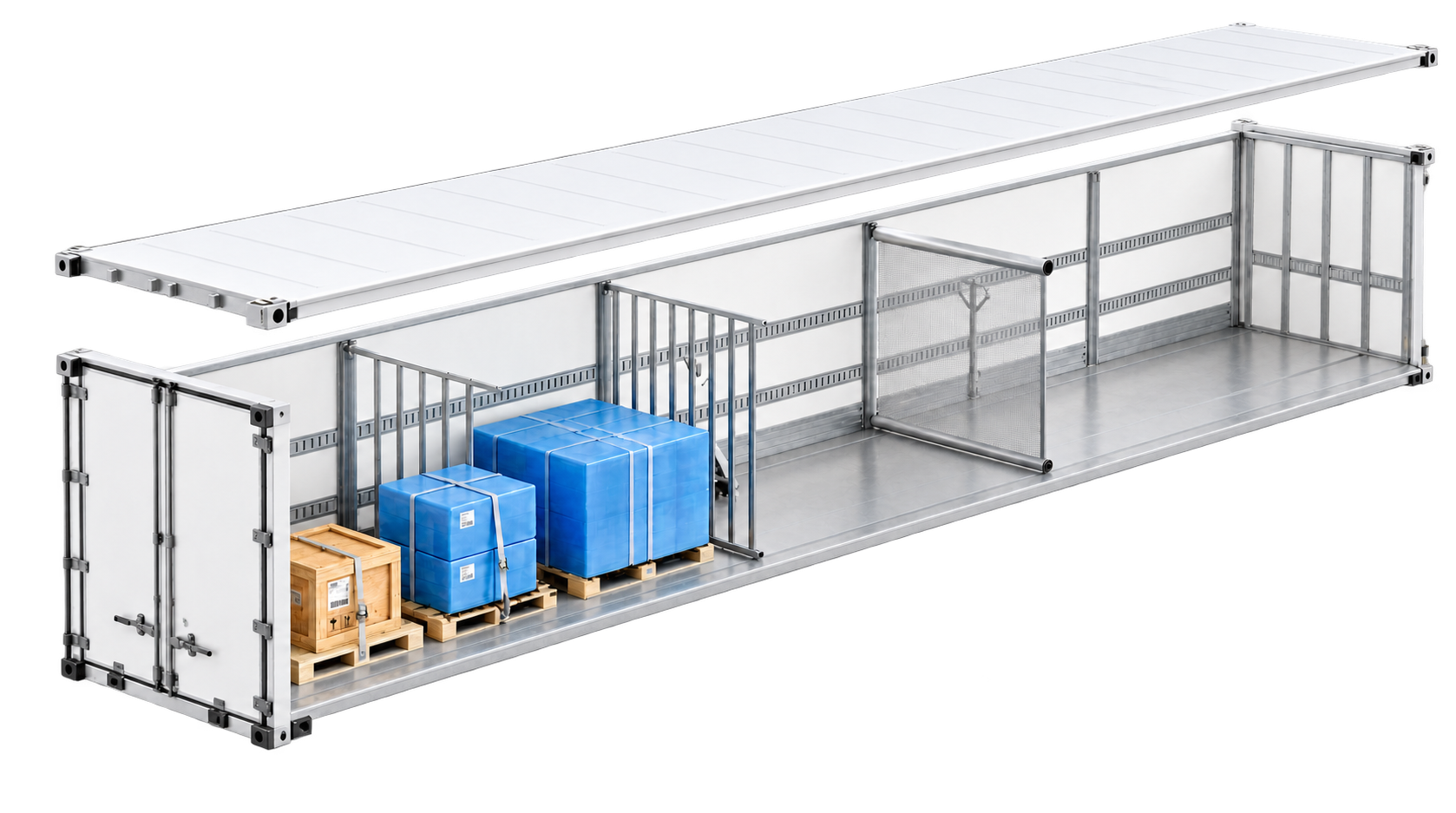
LTL freight moves through a coordinated network of linehaul dry vans, 28-foot pup trailers, and local city delivery trucks equipped with hydraulic liftgates for non-dock access.
LTL linehaul & city delivery units
Pup trailer & straight truck w/ liftgate- Optimal freight scope
- 1–6 pallets
- Payload weight band
- 150–15,000 lbs
- Accessorial capabilities
- Hydraulic liftgate
Density-based pricing; pay only for the trailer weight and cube your freight occupies.
Supports up to 2,500 lbs per piece for facilities without an elevated dock.
Before loading
Packaging integritySecure pallets with 80+ gauge stretch-wrap, band heavy items, and affix PRO labels.
Facility surveyConfirm dock leveler status, hydraulic liftgate requirement, and receiver hours.
LTL network equipment and accessorial services are coordinated based on facility parameters confirmed during quoting.
NMFC classification referenceFreight density, in figures.
Calculate cubic volume and pounds-per-cubic-foot (PCF) density to identify indicative NMFC freight class parameters before requesting carrier dispatch.
Calculated Freight Profile
Indicative estimates- Total volume
- 106.7 cu ft
- Freight density
- 18.8 PCF
≈ 3.02 m³ across 2 units
≈ 300 kg/m³
Plan your LTL shipment.
A precise freight profile ensures accurate carrier rating, avoids surprise re-weigh or re-classification fees, and coordinates required delivery equipment in advance.
Freight profile & NMFC class
Commodity description, pallet count (1–6), footprint (48"x40"), packed height, weight, and NMFC code. Precise dimensions and density establish the correct freight class to prevent carrier invoice adjustments.
Accessorials & dock access
Standard elevated loading dock vs. hydraulic liftgate, pallet jack, or residential / limited access. Flags equipment requirements early so the carrier arrives with the proper final-mile delivery vehicle.
Pickup & delivery details
Shipper and consignee facility locations, operating hours, dock contacts, and receiving windows. Coordinates pickup routing with local terminal schedules and city delivery runs.
Packaging & handling labels
Pallet stretch-wrap (80+ gauge), corner edge-boards, stackability status, and PRO labels on opposite sides. Protects your freight during multiple forklift transfers across regional terminal aprons.
Some details still unknown?
Start with what you have.
Questions, answered.
Need to talk through a particular load? (314) 941-2139
How is LTL freight class determined?
Freight class is established by the National Motor Freight Traffic Association (NMFTA) based on four factors: density (lbs per cubic foot), stowability, handling, and liability. Classes range from Class 50 (dense machinery and metal) to Class 500 (lightweight, fragile cargo). Accurately determining your freight's density upfront protects against carrier re-classification surcharges.
Why is proper pallet packaging so critical for LTL?
In a shared LTL network, freight is typically moved across cross-dock terminal aprons 4 to 8 times by forklifts during transit. Freight must be secured to sturdy pallets using 80+ gauge stretch-wrap bound to the pallet base, protected with corner edge-guards, and clearly labeled with shipping information on opposite sides.
What if our facility or receiver does not have a loading dock?
Tell us whether either facility lacks a dock and whether liftgate, pallet-jack, or inside-delivery assistance is needed. Equipment limits, service scope, and charges must be confirmed with the carrier.
How does LTL transit time compare to Full Truckload?
LTL may involve terminal transfers and different schedules from a direct truckload move. Transit estimates and any time-definite service terms must be confirmed with the selected carrier for the route.
What is Volume LTL or Partial Truckload?
When a shipment occupies 6 to 12 pallets or weighs between 8,000 and 20,000 lbs, Volume LTL bypasses intermediate cross-dock facilities and travels directly on a linehaul trailer. It provides substantial cost savings compared to paying for a full truck while drastically reducing handling touches.
Can I request an LTL quote before every detail is final?
Yes. Start with your estimated pallet count, approximate total weight, origin zip, and destination zip. Our freight coordinators will help verify the proper NMFC classification and recommend the optimal regional carrier options.
Have a shipment
in mind?
Share your freight, locations, and timing to start the conversation.